THE LAFAYETTE SQUARE
1849: We Got This – The St Louis Cholera Epidemic
March 29, 2020/Mike Jones/ 1849: We Got This – The St Louis Cholera Epidemic (an except)
In 1849, a ferocious cholera
epidemic killed from 7 to 10% of the city’s population and decimated the
economy of fast-growing St Louis. In the absence of public health policy,
residents only recourse was a voluntary approach to addressing the crisis. Even
though the cause of the disease was poorly understood, cholera was widely
feared, as it hit fast and hard, sometimes killing victims by dehydration
within a day of exposure.
The city was put on notice in
January, 1849 that cholera was running amok in New Orleans, and city officials
responded by draining its largest body of stagnant water, Chouteau’s Pond. This
was about where Union Station is today. The Board of Health, composed of
members of the Board of Aldermen, endorsed a program of avoiding the
consumption of fish and vegetables to stave off the disease.
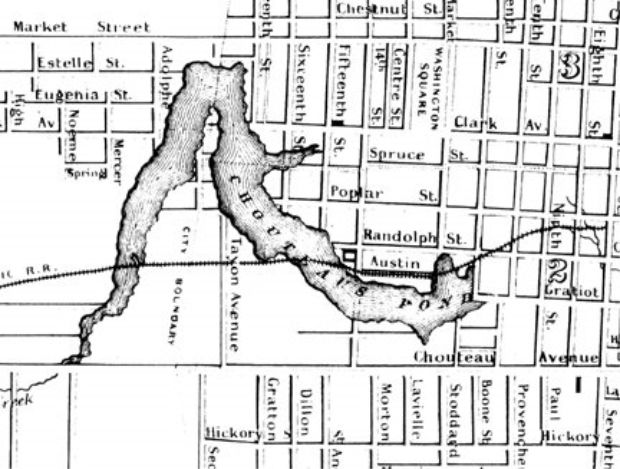
Chouteau’s Pond, between Chouteau and Clark Ave. 1856 map.
1849 was a wild time for people
moving about. Up to 800 emigrants per day arrived in St Louis from the Crescent
City, to wagon west from here for the gold fields. The influx was
overwhelming. The Missouri Republican newspaper estimated that in late June
1849, a third of the population were emigrants. With housing at a premium, many
stayed in slums along the river, adding to the general unhealthy conditions.
This was exacerbated by the complete absence of sewers and garbage collection
in the city. St Louis was primed for disaster.
The disease quickly spread from
emigrants to St Louisans in the spring of 1849, as local newspapers tried to
downplay the situation, in the interest of maintaining business activities. In
May, the Missouri Republican gave up this effort and began printing daily death
figures. By that time “business of every kind (was) nearly suspended.”
The epidemic was actually
overshadowed by an even more imminent crisis on May 17th when St Louis’
business district caught fire. The cholera casualties declined for a couple
weeks, then reached full-blown epidemic status in June and July. No group nor
part of town was safe from its reach. The impact was worst in the filthy area
of Chouteau’s Pond. and it was reported that two-thirds of the inhabitants of
that area died by July 3rd.
Courts were closed as juries refused
to show up, churches and schools were adjourned and orphanages emptied. Doctors
were unable to accomplish much, as the source of the disease wouldn’t be
established for another 34 years. Without understanding the cause, they were
left to attempt treating the symptoms. Prescribed treatments included bathing
at least once a week, avoiding exposure to cold damp weather, foregoing fish
and vegetables, and avoiding public gatherings. Other more invasive methods
involved administration of morphine, mercury compounds, and bleeding the
patient. It must have been maddening to physicians, many of whom worked to
exhaustion on a daily basis and were prone to infection as well.
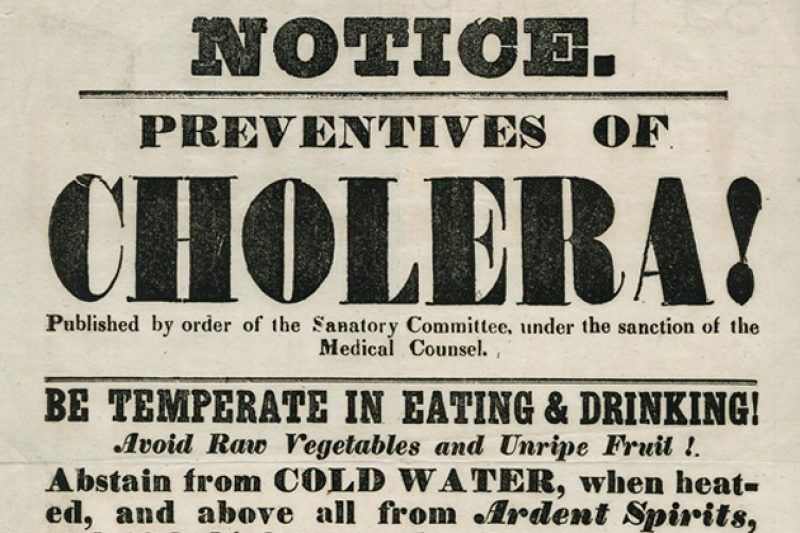
The Board of Health was a subset of
the Board of Aldermen, hardly qualified to deal with public health crises. It
recommended avoiding certain foods and later advised citizens to disinfect
their own property. Talk of creating a sewer system snarled within discussions
of public taxation and the reluctance to sponsor such a measure. Public apathy
ran high as well. People wanted low taxation, but also showed little interest
in improving the plight of the poor in St Louis’ slums or the drainage of fetid
water from the town. It was dangerously “out of sight, out of mind.” Part of
the burden for a lack of awareness and interest was on the newspapers, doing
little to expose the wretched conditions conducive to the spread of
cholera.
City government was limited in
authority, resources and perspective. It failed to respond to the crisis, and
by mid-summer the death toll was well over 5,000.
Thousands of angry, frightened
citizens massed at City Hall on June 25 in heavy rain, demanding that city
officials take action. Several hundred citizens gathered in the Rotunda and
chose Edward Bates (later US Attorney General under President Lincoln) to
preside. He appointed a committee of 12 leading citizens, known as the
Committee of Public Health, and they drew up a list of demands.
The Board of Aldermen passed some
weak public health measures in an effort to save their jobs, but when presented
with the demand to take action or surrender authority, the board, the mayor and
the city council gladly handed over most of their authority to the 12-man
delegation that called on them. The committee took control of virtually all
government functions at the peak of the epidemic.
Immediately, the Committee of Public
Health put its power to use. It organized the city into 3 to 4 block
sub-districts, and appointed inspectors from residents of each district to see
that recommendations were carried out. More than 140 ward inspectors were
appointed to patrol neighborhoods daily, aid the sick, and enforce the
committee’s new sanitation ordinances. They ordered citizens to clean and
disinfect their properties under threat of stiff fines, contracted for “slop
carts” to haul waste away, converted schools into hospitals, that operated at
public expense, employed drivers to take the sick to hospitals and carry the
dead to burial, maintained free drug dispensaries, supplied clean water to the
poor and established a quarantine for steamboats approaching the city. The speed with which they moved would have been
breath-taking in any age.
Epidemics eventually burn themselves
out, but concerted civic action hastened this one’s decline. Without realizing
its full importance, the committee helped stop the spread of the disease by
isolating victims in temporary ward hospitals, away from the rest of the
community.
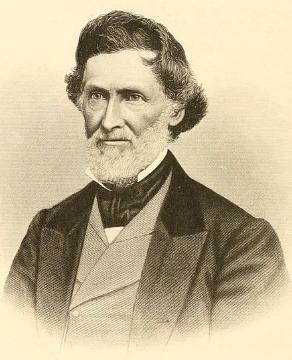
Luther Kennett
The only member of the twelve-man
bipartisan committee that benefitted directly from his service in the 1849
epidemic was Luther Kennett, who emerged as the city’s most popular leader. He
was elected mayor the following year and US Congressman in 1854, when he
defeated Thomas Hart Benton. In 1857, Kennett became president of the Iron
Mountain Railroad. Stephen Barlow was also an officer in the railroad, and
platted Kennett Place in Lafayette Square, named for his associate, former
mayor, and ace organizer.
Interesting how nothing succeeds
like success. The performance of the committee led to a movement to make
medical services available to the poor, and shortly after that, the Sisters of
Charity volunteered to staff a temporary hospital. An orphan’s committee was
organized for each ward of the city. By July 5, committeemen were named to
collect and distribute contributions for children, “made destitute by the
prevailing epidemic.”
Younger St Louisans volunteered time
and effort in the community, and “Sanitation Societies” were formed, composed
of young people helping tend the sick and aid block inspectors.
In a void left by government, church
and the medical profession, St Louisans young and old, businessmen and laborers
responded to the crisis and methodically attacked it. Rather than rely on
unresponsive institutions, they took it on themselves. Volunteers rock.
Voluntary participation made a
success of responding to a hard challenge. As soon as the epidemic ebbed, St
Louis business boomed, putting the charred city back together. By the end of
July, 80 buildings were scheduled for immediate erection and riverboat traffic
resumed. The biggest benefit was a collective awareness of the need to improve
public health. It began an era of creating hospitals and charitable
institutions in the city. It made the public more appreciative of the utility
of taxes toward infrastructural improvements like paved streets and
sewers.
During Luther Kennett’s tenure as
mayor, (1850 – 1853) St Louis constructed its first sewer main, began steps
toward insuring a clean water supply and distribution,
instituted weekly garbage pickup, and organized its fire and police
departments. The city also, in 1852, started a city health department.
They had this.
Please take care of yourselves
during this pandemic. We need your smiling faces.